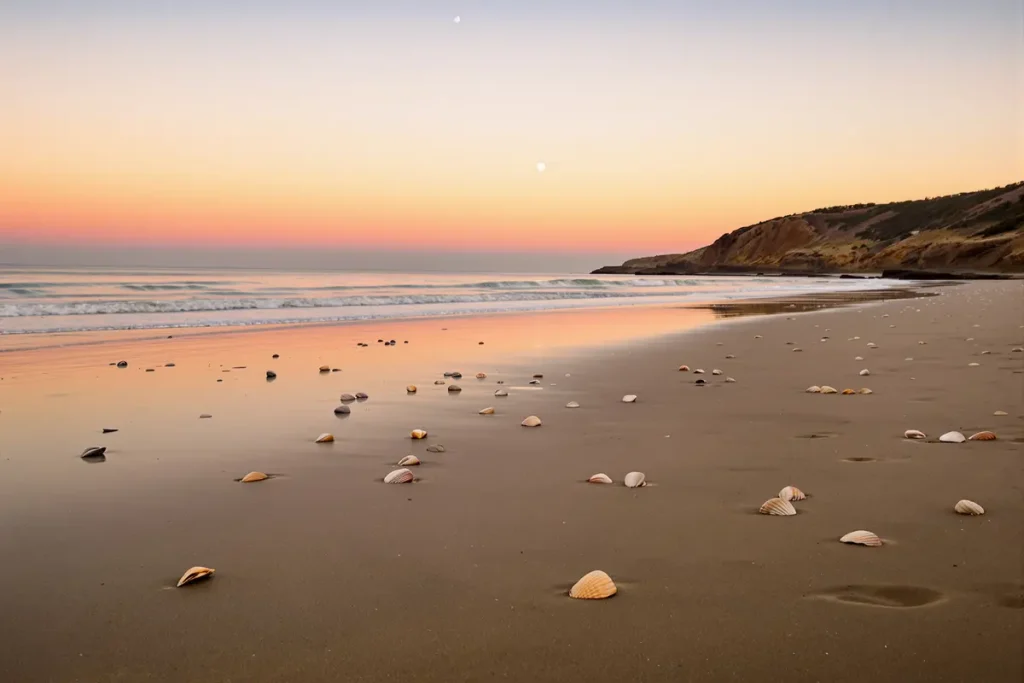
The Moon might look steady in the sky, but it’s not just sitting there. It’s quietly slipping away from Earth, bit by bit. This slow drift might not sound like a big deal, but over time, it’s changing more than you think. From the length of your days to the energy of ocean tides, the Moon’s journey has surprising effects—some that we’re only just beginning to understand.
The day used to be shorter—way shorter
Let’s rewind the clock, all the way back to about 70 million years ago. That’s when dinosaurs still roamed Earth, and something odd was true: days were shorter. A full day back then lasted about 23.5 hours, not the 24 we’re used to now. Why? Earth spun faster, and the Moon was a little closer. That stronger gravitational pull from the Moon affected our oceans and our rotation.
This isn’t just a theory. Scientists found the proof in fossilized shells. Ancient clams, known as Torreites sanchezi, grew in thin layers—like tree rings. A 2020 study revealed that these bivalves had about 372 growth layers per year, which shows Earth had more, shorter days packed into one orbit around the Sun. These fossilized shells are like nature’s timekeepers, giving us a snapshot of the ancient rhythm of life.
Where did the Moon come from and why is it drifting away?
Billions of years ago, a Mars-sized object likely slammed into Earth. The giant impact flung molten rock into orbit, which later formed the Moon. At first, the Moon sat much closer—so close it created massive tides and drastically reshaped coastlines. Earth was spinning so fast back then, a day may have lasted just 6 to 12 hours.
But over time, something fascinating happened. The Moon started to move away—and it still is. Each year, it drifts about 3.8 centimeters farther from Earth. That’s about the rate your fingernails grow. The cause? Tidal forces.
Tides are the secret engine behind the drift
Earth’s rotation and the Moon’s gravity interact in a delicate tug-of-war. The Moon pulls at our oceans, creating two bulges—one facing the Moon and one on the opposite side. But these bulges don’t line up perfectly. Earth spins fast, dragging the bulges slightly ahead of the Moon’s position.
This small shift matters a lot. These ocean bulges pull on the Moon, giving it a forward “nudge.” That extra energy sends the Moon into a higher orbit, slowly pushing it away. Meanwhile, Earth loses a bit of spin energy, making days just a tiny bit longer over time.
Lasers confirm the Moon is really moving
Apollo astronauts left special mirrors on the Moon—called retroreflectors. Today, scientists shoot lasers from Earth and time how long it takes light to bounce back. These ultra-precise measurements show the Moon’s distance growing year by year.
- Laser pulses travel from Earth to the Moon.
- Mirrors reflect them back to Earth.
- The round-trip time tells us the Moon’s exact position—within millimeters.
This method gives us reliable proof that the Moon is slowly backing away—and taking a tiny bit of Earth’s rotational speed with it.
What does this mean for our future?
If nothing else interferes, this story could continue for millions—even billions—of years. As the Moon moves away, days on Earth will get longer, and tides will grow weaker. The Moon’s strong pull is what gives tides their power today, especially around coasts with wide, shallow seas.
In the very distant future, Earth and the Moon could become “tidally locked” to each other. We already see one side of the Moon all the time because it’s tidally locked. If Earth reached that same state, it would only rotate once every 27 days. That means one side of Earth would always face the Moon, while the other wouldn’t see it at all.
In that scenario, tides would nearly stop moving. Coastal ecosystems would be completely different—possibly unrecognizable. But don’t worry just yet. This extreme future likely won’t happen, because our Sun has other plans.
The Sun will interrupt everything
In about a billion years, solar brightness will increase, causing Earth’s oceans to slowly evaporate. Without oceans, there’s nothing for the Moon to pull at—so tidal drag would disappear. Later, as the Sun swells into a red giant, it may engulf Earth and the Moon entirely.
So in short, the Moon’s drift is slow, but cosmic change is still coming. And the Sun might beat the Moon in the race to reshape our planet.
What we’ll notice sooner
Even though most of these changes happen over unimaginably long timescales, some effects start to show up sooner.
One example is solar eclipses. As the Moon moves farther away, it appears smaller in our sky. That means total solar eclipses, where the Moon perfectly covers the Sun, will get rarer. In a few million years, we might only see “annular” eclipses—a glowing ring of sunlight around the Moon’s shadow.
Also, the range between high and low tide is already changing—subtly, but steadily. Over time, tides will grow quieter. Coastal flooding events will still occur, especially with storms, but the long-term average energy of the tides will dip.
What the Earth-Moon dance reveals about life
By studying rock layers and ancient shells, scientists can trace this drift deep into our planet’s past. These findings don’t just teach us about time and tides—they help us model climate history, planetary behavior, and even what life might look like on distant worlds.
On planets with big moons, tides may help mix ocean layers, keep temperatures stable, and even support life. The Earth-Moon connection gives researchers a real-life lab to compare with exoplanets.
So next time you stand at the beach staring at high tide, remember—it’s not just water moving. It’s time. The Moon’s slow pull is rewriting history, shaping coastlines, and telling us a larger story. Our planet’s rhythm is changing, one centimeter at a time.